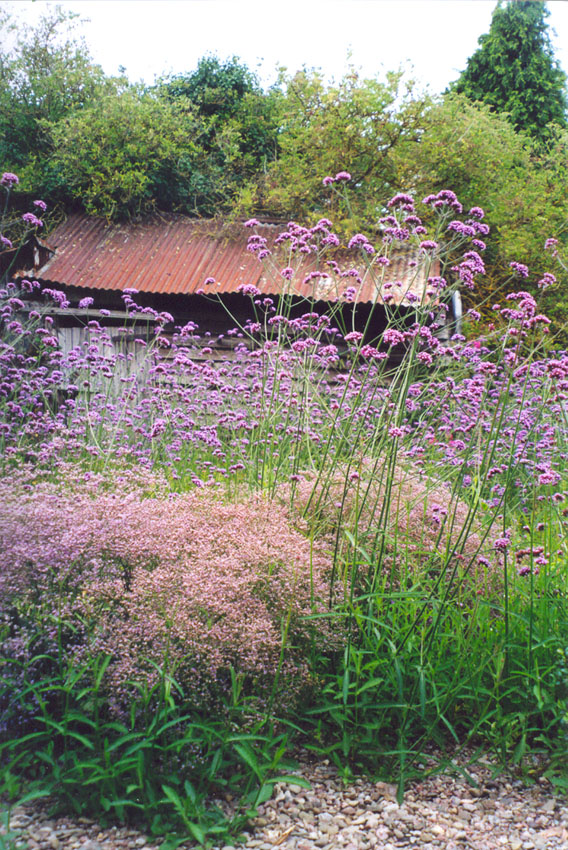
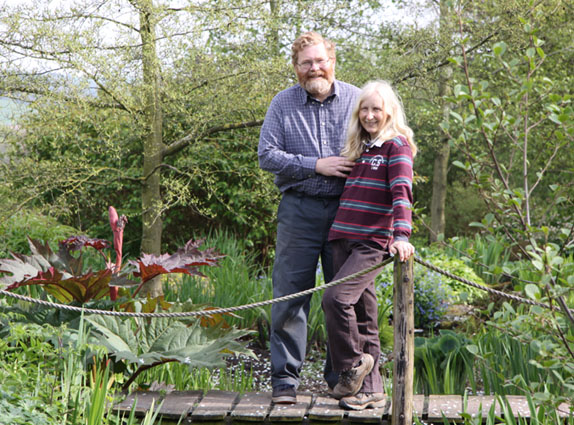
Aulden Farm Home Page Aulden Farm is situated in the beautiful rolling countryside of the Welsh Marches. In 1997, it was a barren site with a magnificent ash and a number of very old cider apple trees, for this is cider making country. Now, numerous nooks and crannies abound and the ash stands proudly in its own space looking over the fields towards Clee Hill. The garden extends to some three acres in size and surrounds an old farmhouse. The farmhouse itself is an interesting mix, part Victorian with a cider cellar and part traditional black and white dating from the late 1600s. The soil is typical Herefordshire clay and our remit has always been to work with nature and the countryside around us. So, the result is an informally planted garden full of wildlife, with many different aspects to explore and enjoy. The pond is literally a hole dug in the ground, the clay has not been puddled and is a haven for the local toads, newts and endless frogs. The shallow edge allows access for the hedgehogs to drink and provides an area for the birds to bathe. We have surrounded it with some of our collection of siberian iris and other moisture loving favourites such as ligularia and the creeping shuttlecock fern. By nature, we are plantaholics and the garden does reflect this, but we have also tried to use the plants in our own idiosyncratic way; an area we call Great Grans contains dark and dusky colours with Smyrium perfoliatum giving zing to the area in spring. Hemerocallis are well represented with over 100 planted in colour co-ordinated stock areas. By dividing the site, we have created sheltered areas, a necessity for although we are low lying, it is a windy spot, with views to the Shropshire Hills to the north and the Welsh Hills to the west It also gives a feeling of mystery, described as an 'Alice in Wonderland garden' by a younger visitor, but it is also practical. It creates smaller intimate areas that are easier for us to maintain, for we have no help and the nursery is also a fairly full time occupation. We now hold the National Collection of Siberian Iris and this is planted in an area we fondly call the allotment. They are planted in chronological order so that you can see the progress and change in style over the years, starting with 'Snow Queen' introduced in 1900 through to the present day. Generally, the best time to see them in flower is late May, early June, depending on the season. Opening Times: We are open Tuesday & Thursday 10am-5pm from April to August inclusive and Thursdays only in September. However, visitors are welcome at other times by arrangement. We are also open some Sundays for the National Garden Scheme�18th April, 30st May, 27th June and 12th September 2010 (2.00-5.30pm). Homemade ice cream is available on these days. Groups are also very welcome, evenings or during the day, and we can supply tea/coffee and homemade cake - so please enquire. For those interested in irises, we can give 2 talks at present; Irises for the Natural Garden (concentrating on beardless irises) or Irises - some history, some people, some plants (a more general talk on irises). Alun & Jill Whitehead
|